After reviewing thousands of pitch decks and watching clients raise more than $1.6B, we've learned something that surprises most founders: the decks that win aren't the prettiest ones. They're the ones that make investors instantly understand the opportunity, believe the story, and see why this specific company, with this specific team, can win.
That's a harder thing to build than it sounds. And AI has made it both easier and harder to get right.
The Pitch Deck Landscape Has Changed
AI has made it easier than ever to produce a pitch deck. In minutes, you can generate polished slides, clean layouts, and confident-sounding copy. What AI hasn't made easier is knowing what actually deserves to be on those slides in the first place.
That gap, between looking investor-ready and being investor-ready, is where we've seen the most founders get stuck. A deck can be visually flawless and still fail to answer the one question an investor is actually asking. And a deck can look almost plain and still raise millions, because it answers that question clearly, on the first pass.
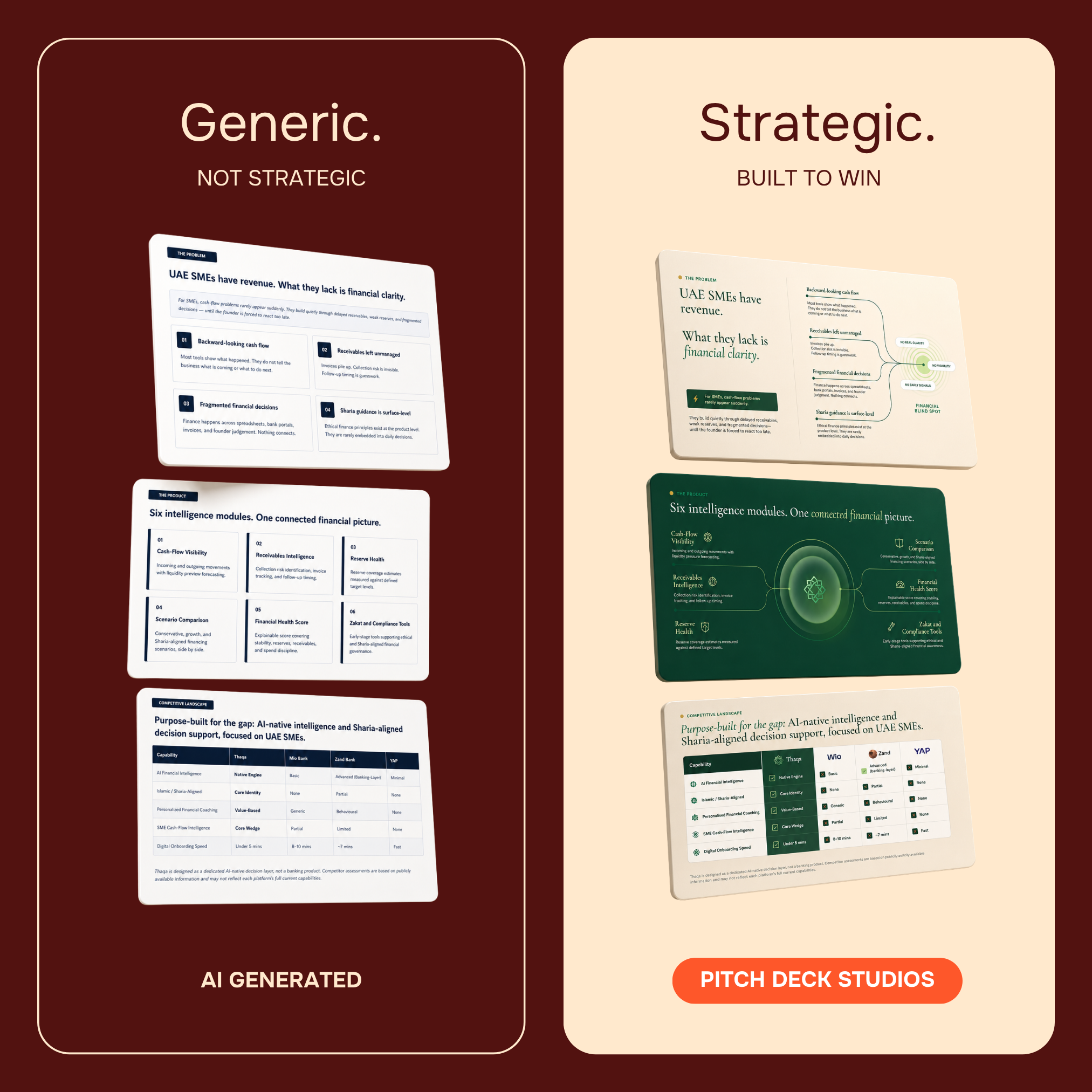
This is really the core comparison worth making: not "AI versus no AI," but AI-generated decks versus decks built through real research, strategy, and storytelling.
What We've Actually Seen, Across Thousands of Decks
Some of the strongest-looking decks we've worked on didn't perform. Some of the simplest ones helped founders raise significant rounds. The difference was never really about design polish. It was about whether the deck did four things well:
Research: understanding the market and the investor's frame of reference well enough to anticipate their questions
Content: including only what moves the story forward, and cutting what doesn't
Storytelling: building a narrative arc investors can follow and remember, not just a stack of facts
Design: using visual clarity to support the story, not to disguise a weak one
When those four things come together, a deck does its actual job: it helps an investor understand the opportunity fast, believe the story, and picture themselves backing it.
Where AI Fits and Where It Doesn't
AI-generated content and AI-built presentations can be genuinely useful for speed: drafting a first pass, cleaning up formatting, generating variations. What they can't do is replace the strategic thinking behind a deck that's built to raise money, the judgment about what an investor in this specific space needs to see, in this specific order, to move from skeptical to convinced.
The visible gap between an AI deck and a strategy-built deck is design polish, and AI has mostly closed that gap. The invisible gap, the one that actually decides whether a round closes, is everything AI can't yet see: the story underneath the slides, the questions it anticipates, the objections it defuses before an investor even raises them.
This is one of the biggest mistakes we see founders make with AI-generated decks, and it's exactly what we're covering live on September 30. Get your spot →
So, Pitch Deck Studios vs. AI — What's the Real Answer?
Not a rivalry. AI is a tool that's genuinely useful for speed and a first draft. It is not, on its own, a substitute for the research, positioning, and storytelling work that determines whether a deck actually convinces someone to write a check. The founders who raise well tend to use both: AI where it helps them move fast, and real strategic thinking everywhere it matters.
Want to go deeper on this? Join our live session on September 30 walking through more before/after examples, the biggest mistakes we see across thousands of decks, and a 5-question test you can run before sending your next deck.
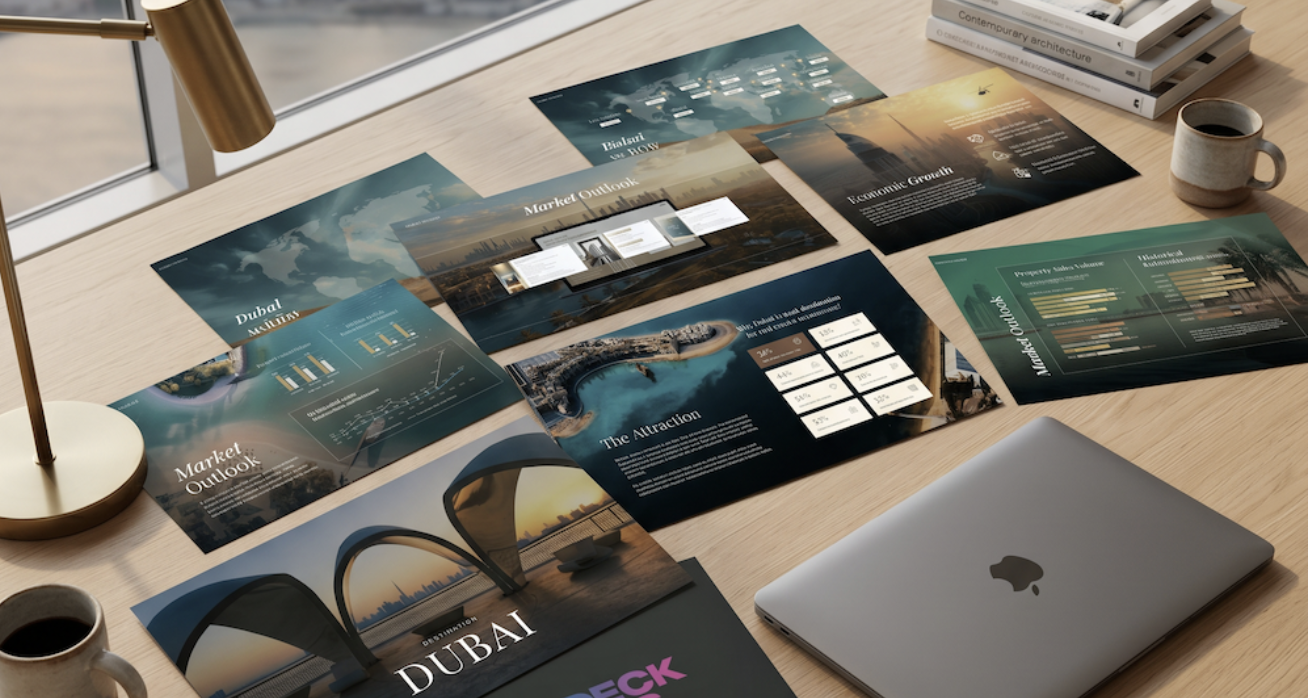
Real estate documents do more than close deals, they set the first impression. See what they include, why they matter, and how stronger design helps you sell the vision, not just the property.
Investor Pitch Deck
Startup Pitch Deck
AI Pitch Decks Are Everywhere. But Investors Still Want Human Judgment.
AI can generate a polished pitch deck in minutes, but investors are judging the strategic thinking behind it, not just the slides. Here's why human judgment remains the real differentiator in fundraising.
Investor Pitch Deck
Startup Pitch Deck
Master Template: The System That Works for the Entire Team
A master template turns scattered, off brand decks into one consistent presentation system giving sales, marketing, product, and leadership a shared foundation they can actually use.
Contact us
Thank you! Your submission has been received!
Oops! Something went wrong while submitting the form.

.svg)

.svg)

_v3.png)
_v3.png)

.avif)
.avif)



.svg)
