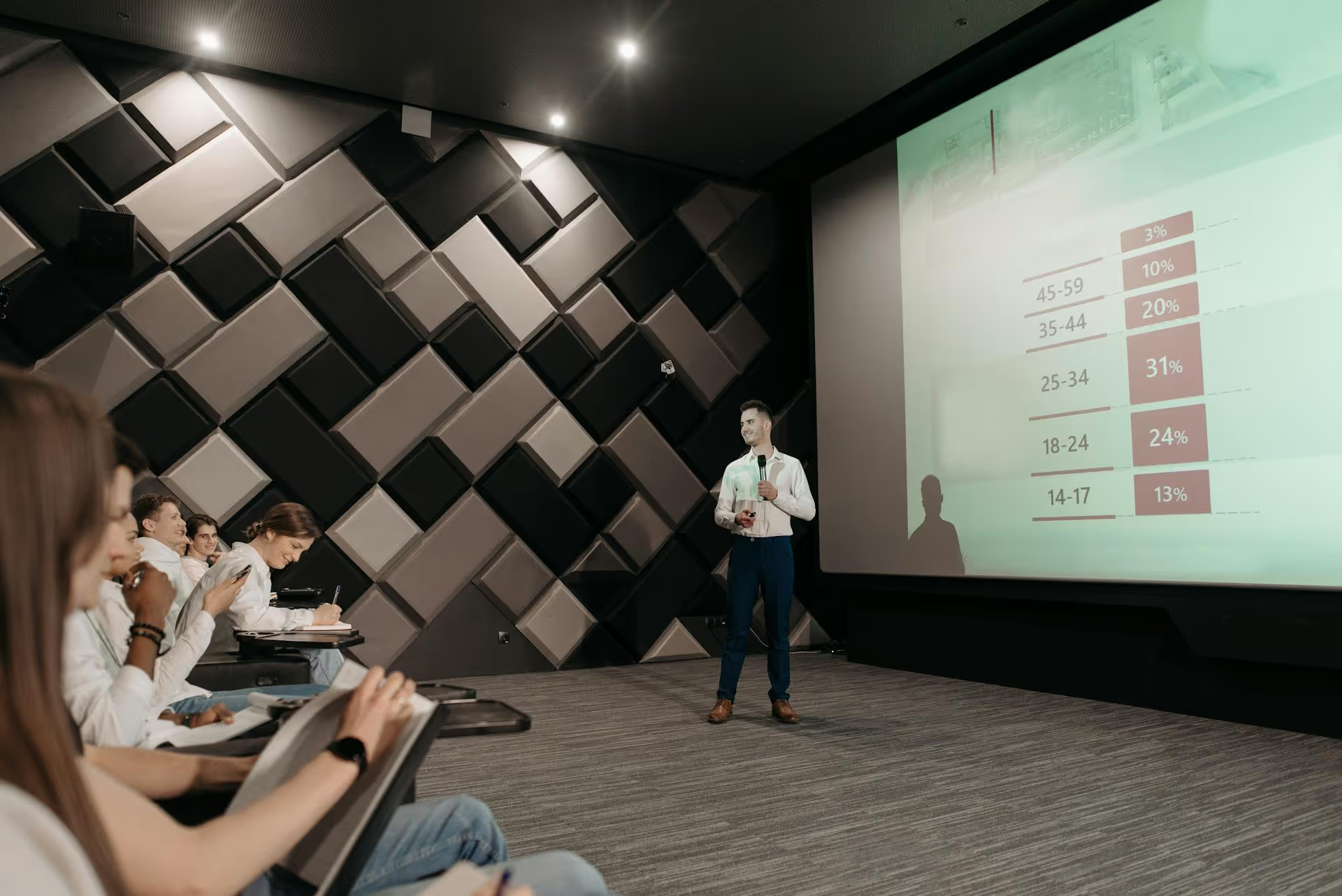
There’s a moment, just a few seconds into a presentation, where everything hangs in the balance. A beautifully designed slide appears. The speaker takes a breath. The audience leans in—or checks their phones. What happens in that fleeting window is more than a test of design; it’s a reflection of something deeper, something wired into us: the fragile, elusive nature of human attention.We like to think that if our content is good enough, people will naturally pay attention. But anyone who’s ever watched an audience zone out before the second slide knows that’s not the case. In truth, presentation design has become an unexpected window into how modern humans focus, process, and engage with information—and perhaps more importantly, how quickly we tune out.So today, let’s explore not just how to design better presentations, but what those very design principles reveal about how attention works in the first place.
The myth of the goldfish attention span
By now, you've probably heard the infamous claim that humans have a shorter attention span than a goldfish—supposedly just eight seconds. While this particular comparison has been largely debunked (goldfish deserve better, frankly), the broader point stands: our attention is under siege.But here’s what’s interesting. Research shows we don’t have a shorter attention span per se—we have a more selective one. We’ve become incredibly skilled at filtering, prioritizing, and scanning. This isn’t a failure of focus; it’s an adaptation to information overload. In other words, our brains aren’t broken—they’re just overwhelmed.That’s where presentation design becomes such a powerful lens. Great design doesn’t fight for attention; it earns it. It doesn’t bombard with data; it guides the mind. The more intentional the design, the more aligned it is with the way we now process the world.
The slide as a cognitive shortcut
Think of a slide as more than just a visual. It’s a tool for cognitive alignment. In a matter of seconds, a well-designed slide can tell your audience: this is what matters, this is how it connects, and this is what you should remember.It’s no accident that modern slides tend to rely on bold headlines, strong visual hierarchy, and limited text. These aren’t just aesthetic choices—they’re cognitive strategies. Our brains crave clarity. When too much is presented at once—dense bullet points, cluttered layouts, inconsistent formatting—the mental effort required to decipher it becomes a barrier to engagement.Neuroscience backs this up. The brain processes images 60,000 times faster than text. Visuals activate both the occipital lobe and parts of the limbic system, triggering emotional response and memory. It’s why a single photograph can communicate more than an entire paragraph of explanation. It’s also why clutter kills attention. Because every unnecessary visual element becomes one more thing for the brain to sift through—and attention only has so much bandwidth.
Micro-moments and the art of flow
A presentation isn’t a monologue; it’s a sequence of micro-moments. Each slide is an invitation to stay with the story—or to leave it. And it only takes one overly busy layout or one rambling point to break the flow.Attention is a rhythm, not a light switch. And design plays a vital role in preserving that rhythm. By pacing information delivery—one idea per slide, clear transitions, consistent structure—you reduce cognitive friction. You make it easier for your audience to stay immersed.We see this principle at work in some of the world’s best pitch decks. Take Airbnb’s famous original deck: each slide is minimalist, focused, visually clear. You don’t need to “read” the slide—you get it. That’s no accident. It’s attention-aware design in action.
The hidden power of white space and silence
Let’s talk about what’s not on the slide.One of the most undervalued design elements is white space. Not just in a visual sense, but in a psychological one. White space gives your audience’s brain room to breathe. It reduces fatigue. It communicates confidence. You’re not cramming every inch with content because you trust your message—and your audience—to connect.Similarly, in spoken delivery, silence can act as a design element. A well-timed pause allows the brain to catch up, to digest, to reflect. It resets attention. In a world of constant input, those small gaps in sound and space can become the most memorable parts of the experience.Presentation design teaches us that sometimes the most powerful thing you can say is... nothing. Just a clean slide. Just a pause. Just a moment.
What this means for hHow we work, sell, and communicate
Let’s zoom out. What does all this tell us, not just about design, but about ourselves?It tells us that attention is a currency—and like all currencies, it has value only when it's respected. That respect shows up in how we communicate: Do we design with the user’s mind in mind? Do we reduce noise and increase meaning? Do we tell stories that flow instead of dumping facts that drown?The lessons from presentation design apply far beyond pitch decks. They’re relevant in every email you write, every product you explain, every conversation you lead. Because whether it’s a slide, a screen, or a sentence, the real task is always the same: earn attention, hold attention, and make that attention worthwhile.
Final thoughts: the audience is not the problem
It’s easy to blame modern attention spans for disengagement. But the audience isn’t the problem. The problem is how we communicate in a world that’s louder and faster than ever.Presentation design, when done right, is a reminder that the human brain is still wired for clarity, story, and beauty. That when we respect attention, we get more of it. And that the smartest message in the world means nothing if it gets lost in the noise.So the next time you design a slide—or sit through one—pay attention to what’s grabbing your attention. The science behind it might be saying more than the words themselves.
Written by:
Tags:
Pitch deck design
You May Also Like
Investor Pitch Deck
AI Pitch Deck
September 15, 2026
Pitch Deck Studios vs. AI: What $1.6B in Raised Capital Taught Us
After reviewing thousands of investor decks and watching clients raise more than $1.6B, we've learned the decks that win aren't the prettiest ones. Here's what AI can and can't do about that.
Real Estate Pitch Deck
Investor Pitch Deck
July 23, 2026
Real Estate Documents: What They Are
Real estate documents do more than close deals, they set the first impression. See what they include, why they matter, and how stronger design helps you sell the vision, not just the property.
Investor Pitch Deck
Startup Pitch Deck
AI Pitch Decks Are Everywhere. But Investors Still Want Human Judgment.
AI can generate a polished pitch deck in minutes, but investors are judging the strategic thinking behind it, not just the slides. Here's why human judgment remains the real differentiator in fundraising.
Contact us
Thank you! Your submission has been received!
Oops! Something went wrong while submitting the form.
.svg)

.svg)



.avif)



.svg)
